Research
Research Directions
We employ computational approaches to address fundamental challenges in two-dimensional materials for quantum and electronic applications, spanning inverse materials design, synthesis science, and defect and interface engineering. Our expertise is in density functional theory (DFT), molecular dynamics (MD), machine-learning interatomic potentials (MLIPs), transport modeling, and high-throughput computations.
1 Inverse Design
Inverse Design of 2D Quantum Materials
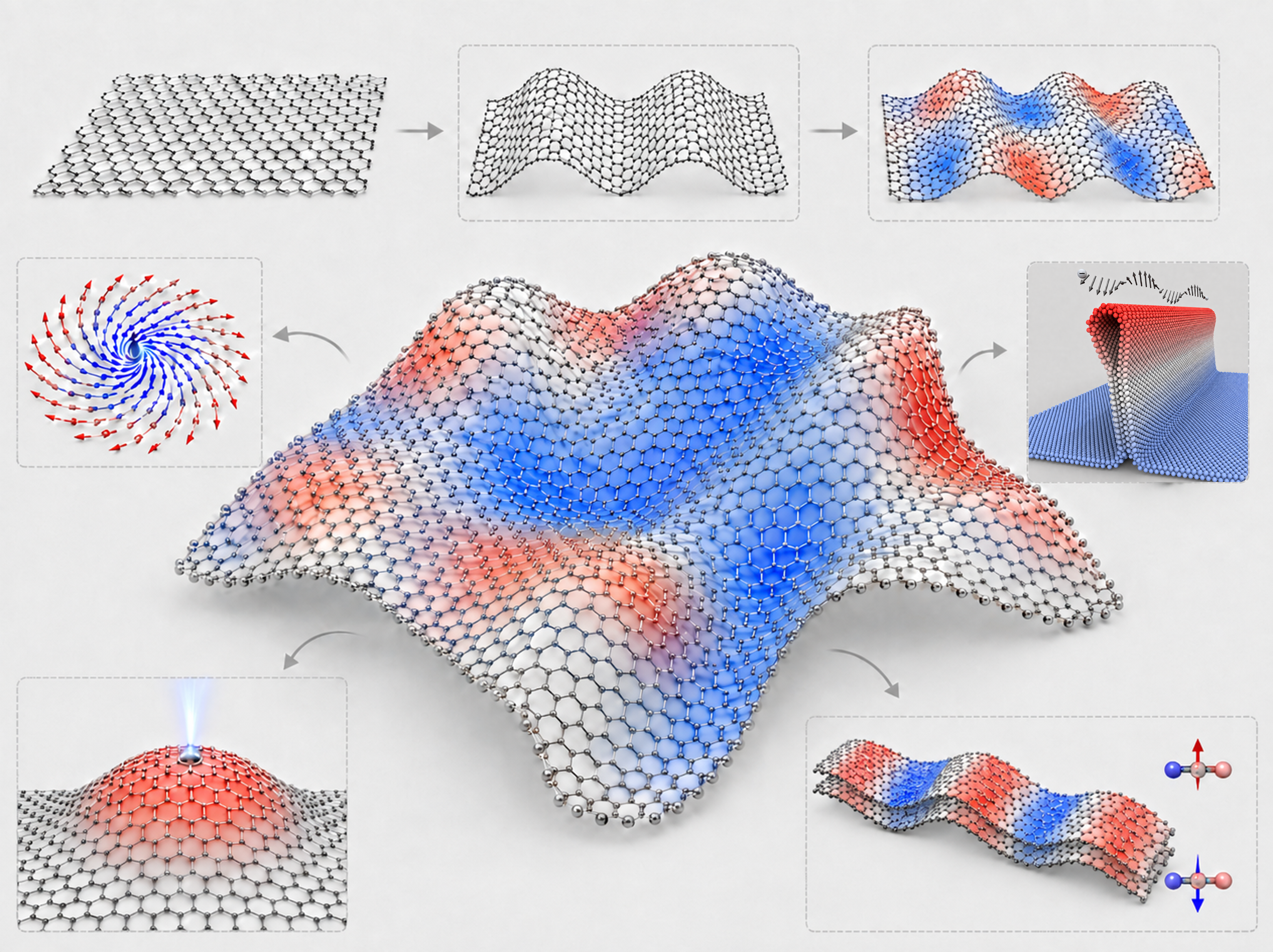
Discovering materials with targeted functionalities is central to next-generation electronic and quantum technologies. But must new materials always be discovered to realize new functionalities? We aim to establish a new paradigm in which topographical deformations are used to engineer emergent electronic and quantum phases in 2D materials, moving beyond serendipitous materials discovery toward geometry-driven design.
More about this research ↓Less about this research ↑
Using multiscale computational approaches, we investigate how deformation-induced pseudo-electric and pseudo-magnetic fields reshape electronic structure and give rise to correlated electronic states and exotic optical and magnetic properties. By connecting a prescribed deformation profile directly to an effective electronic Hamiltonian, we seek to develop general design rules for creating targeted quantum phases through geometry. This approach could provide a versatile route to tune spin, charge, optical, and magnetic behavior without changing the underlying material composition. Ultimately, this framework could enable tunable quantum functionality for sensing, logic, memory, and other emerging electronic technologies.
Representative Publications
- Undulation-induced moiré superlattices with one-dimensional polarization domains and flat bands in two-dimensional bilayer semiconductors, Phys. Rev. B, 2025, 112, 115308 - Editors’ Suggestion
- Mechanical crease in 2D materials – a platform for large spin-splitting and persistent spin-helix, Matter, 2025, 8, 102378 - † corresponding author; featured on Rice News
- Designing 1D correlated-electron states by non-Euclidean topography of 2D monolayers, Nature Commun., 2022, 13, 3103 - featured on Rice News, Materials Today, Physics World
2 Synthesis Science
Predictive Synthesis
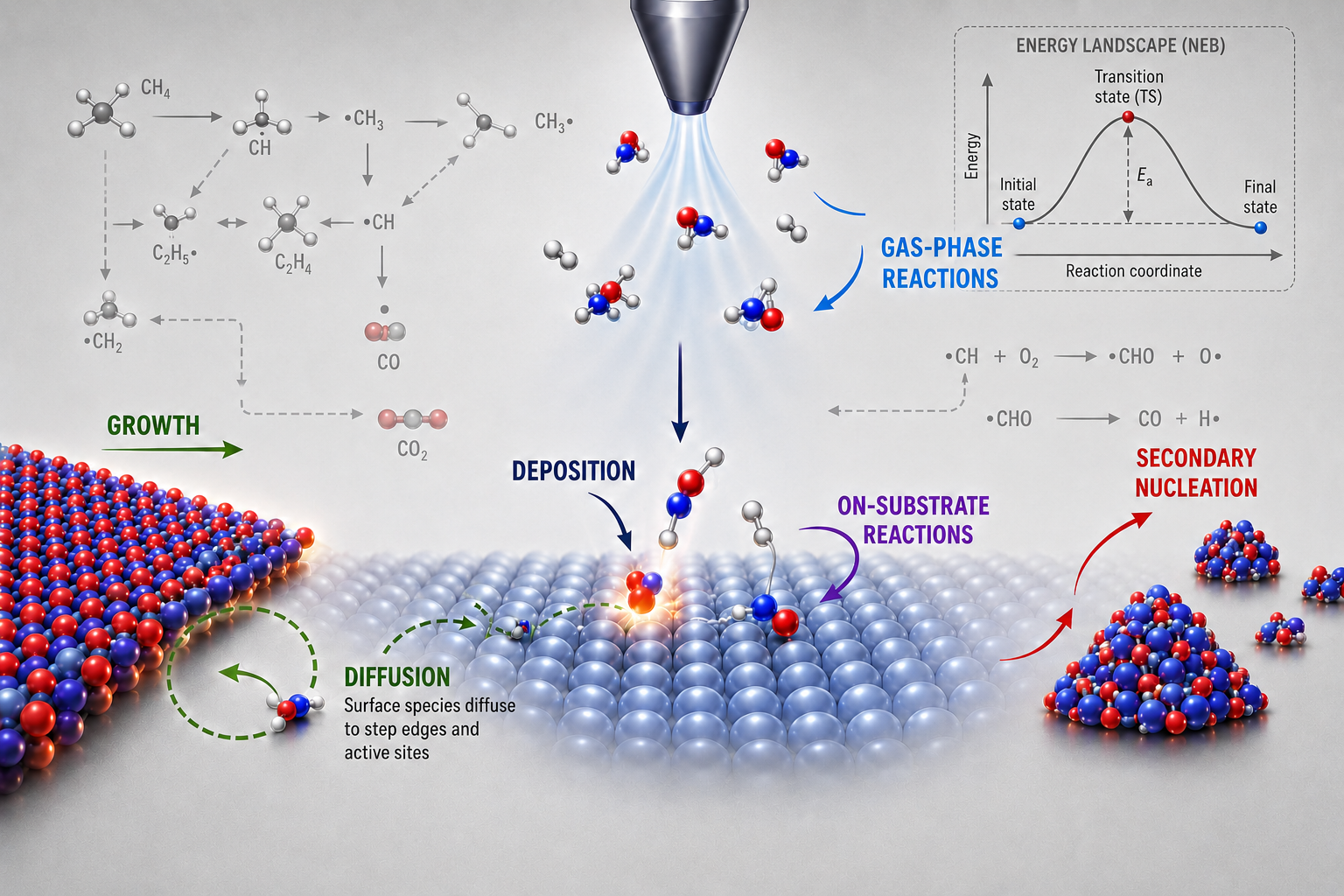
Synthesis remains a major bottleneck in realizing the potential of 2D materials. Can modeling approaches predict synthesis conditions rather than merely explain growth post facto? Using ML-based interatomic potentials coupled with thermodynamic and kinetic models, we develop predictive frameworks for CVD growth that connect precursor chemistry, nucleation, and crystal growth across multiple time and length scales.
More about this research ↓Less about this research ↑
We are also broadly interested in extending these approaches to predict synthesis pathways and processing conditions for bulk functional materials. Ultimately, this work aims to establish a general framework for rational synthesis design, enabling lower growth temperatures, reduced defect densities, improved crystal quality, and more reliable synthesis of targeted materials and phases.
Representative Publications
- Fast Room-Temperature Mg-Ion Conduction in Clay-Like Halide Glassy Electrolytes, Advanced Energy Materials, 2024, 2400163 - * equal contribution
- What dictates soft clay-like Li superionic conductor formation from rigid salts mixture, Nature Commun., 2023, 14, 6884
- Thermoelectric transport and microstructure of optimized Mg2Si0.8Sn0.2, J. Mater. Chem. C, 2015, 3, 10467–10475 - * equal contribution
3 Defects & Interfaces
Defect & Interface Design
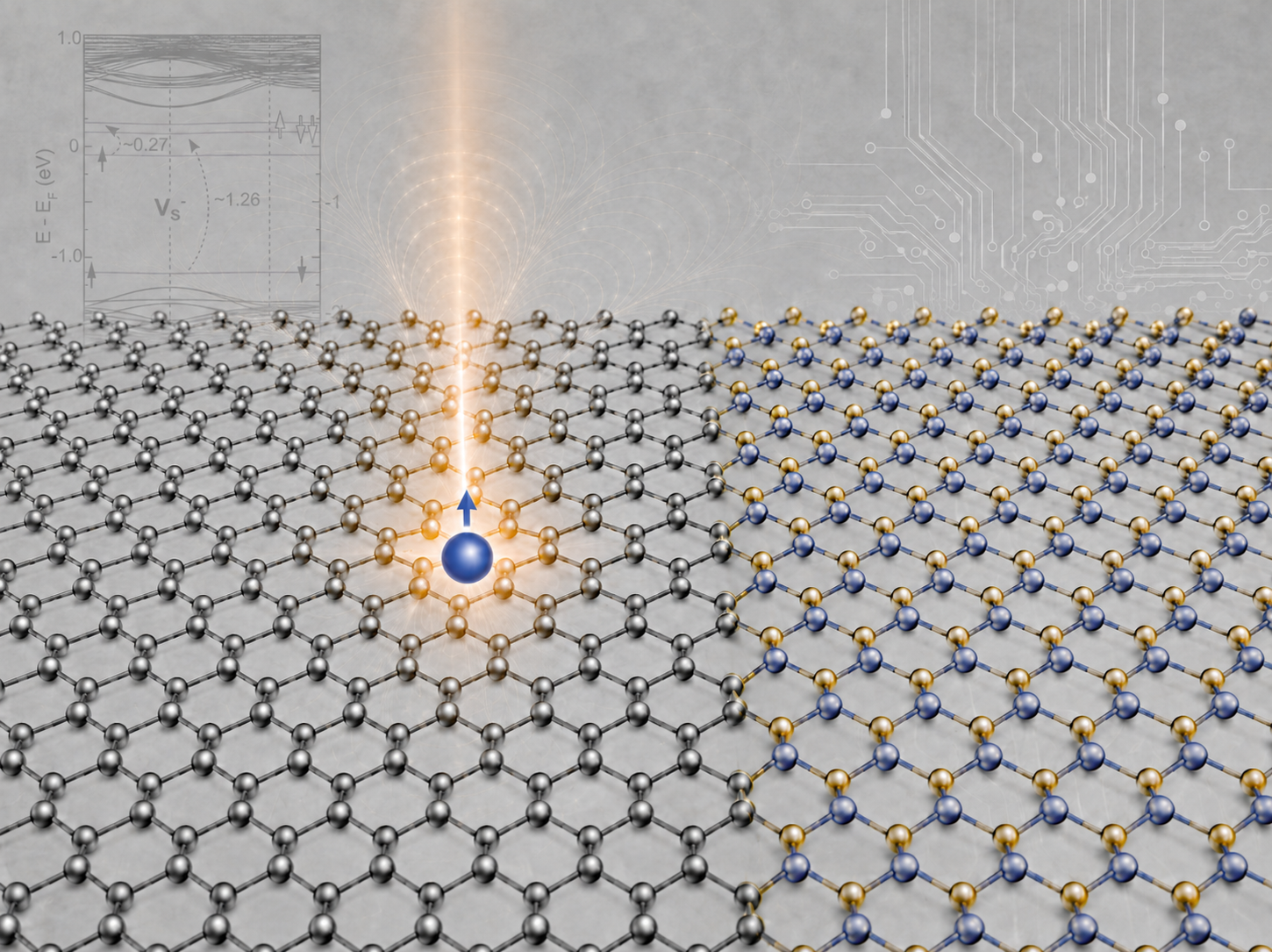
Although defects and interfaces are imperfections in materials, they are critical for integrating materials into functional devices. Can we develop a predictive framework for designing them during integration of 2D materials into quantum and electronic technologies? We aim to develop computational design principles for defects, interfaces, and quantum coherence.
More about this research ↓Less about this research ↑
For quantum technologies, we use high-throughput first-principles and open-quantum-system approaches to identify defect-based spin-photonic qubits with favorable optical, spin, and coherence properties and to understand their decoherence mechanisms. For advanced microelectronics, we combine first-principles calculations, continuum electrostatics, and quantum transport simulations to investigate contacts, doping, interfaces, and transport in emerging 2D materials. Ultimately, this work will enable rational design of materials and device architectures for quantum information processing and energy-efficient electronics.
Representative Publications
- Single-photon emission from two-dimensional materials, to a brighter future, J. Phys. Chem. Lett., 2023, 14, 3274–3284 - Perspective, Invited
- Dimensionality-reduced Fermi-level pinning in coplanar 2D heterojunctions, J. Phys. Chem. Lett., 2021, 12, 17, 4299–4305 - Cover Article
- Two-Level Quantum Systems in Two-Dimensional Materials for Single Photon Emission, Nano Lett., 2019, 19, 408–414 - featured on Rice News and Rice engineering magazine 2019